
Culinary innovation is transforming the modern kitchen in ways that go far beyond robots and futuristic equipment. From precision cooking and AI-powered waste tracking to induction technology and 3D food printing, new tools are helping chefs improve consistency, reduce waste, and work more intelligently while keeping human skill at the heart of the dining experience.

For most of culinary history, innovation arrived quietly. Someone discovered that microorganisms could transform milk into cheese. A cook learned that grinding grain more finely changed the character of bread. Canning, mechanical refrigeration, pressure cooking, and controlled-temperature ovens eventually altered what kitchens could preserve, prepare, and serve.
Today’s culinary innovations can appear considerably more futuristic. Artificial intelligence can help a restaurant identify what is being discarded. Induction equipment can deliver highly responsive heat without an open flame. Three-dimensional food printers can deposit edible mixtures into shapes difficult to produce by hand. Scientists are using fermentation in increasingly precise ways to develop ingredients with specific functions and sensory qualities.
Yet the most important culinary innovation is rarely technology for technology’s sake. A new tool matters only when it solves a problem, improves consistency, reduces waste, expands creative possibilities, or allows cooks to devote more attention to the work humans do best.
The kitchen of the future, then, may not be one in which machines replace cooks. It may be one in which technology becomes increasingly invisible—quietly helping cooks understand ingredients, control processes, and make better decisions.
Innovation Has Always Belonged in the Kitchen
The image of traditional cooking can make culinary innovation seem like a recent disruption. History tells a different story.
A refrigerator would have seemed revolutionary to a cook accustomed to preserving food with salt, smoke, ice, or fermentation. Commercial canning fundamentally changed the distance food could travel and the length of time it could remain usable. Mechanical mixers altered bakery production, while temperature-controlled ovens made consistency possible on a scale difficult to achieve with wood and coal.
Even the thermometer represented an important change in culinary thinking. Instead of relying entirely on appearance and touch, cooks could measure what was happening inside food.
Today’s digital technologies continue that progression.
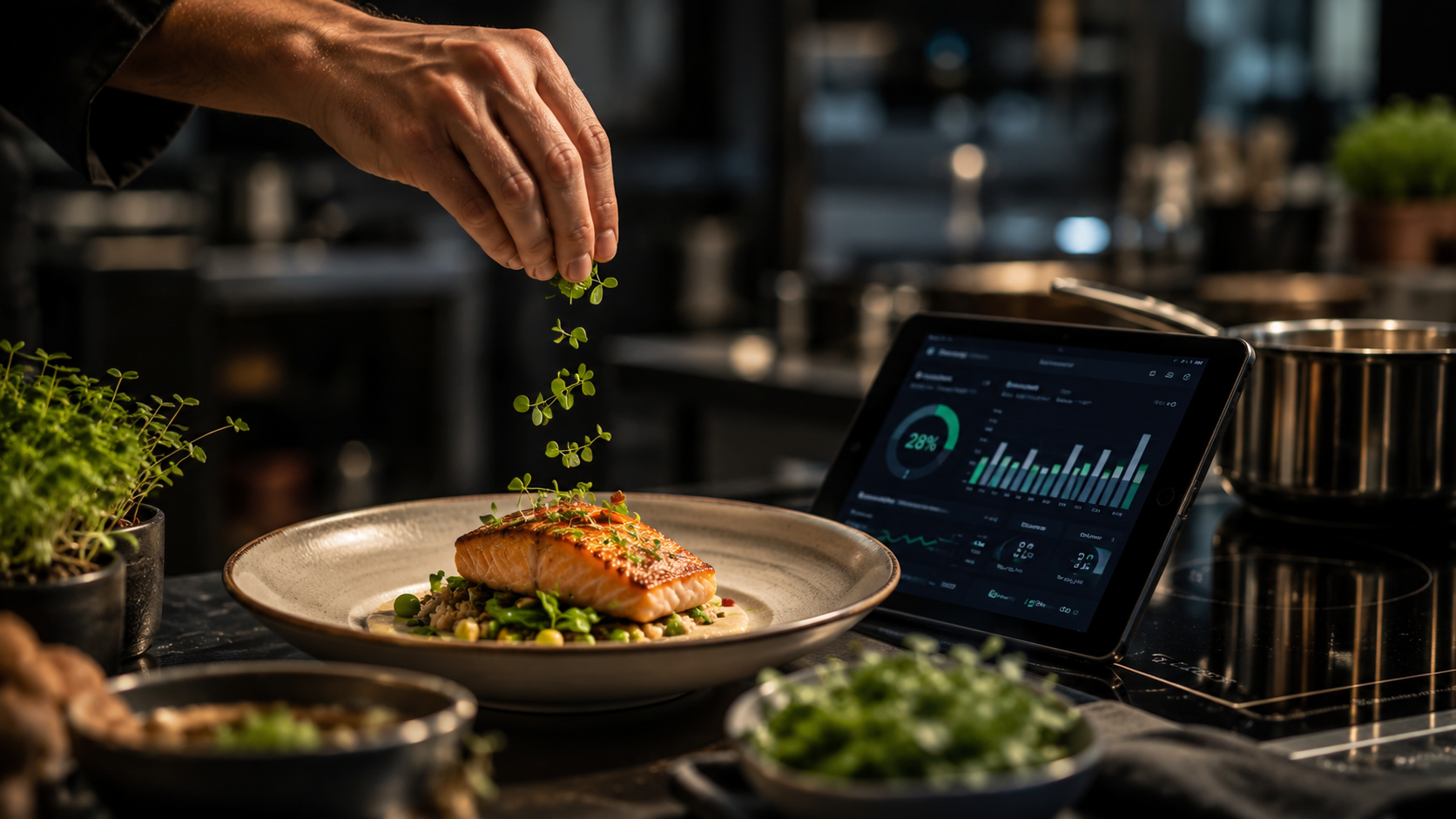
The distinction is that modern equipment can increasingly collect information as well as perform a task. A scale can measure waste and record what was discarded. A connected oven can repeat a temperature program precisely. Software can analyze purchasing and sales patterns that would be difficult for a person to recognize manually.
The kitchen is becoming not simply more mechanized, but more measurable.
Precision Is Replacing Guesswork
Professional cooking has always required judgment. Innovation does not eliminate that judgment; in many cases, it gives cooks better information upon which to base it.
Consider temperature.
Traditional techniques often depend on sensory cues: the sound of oil, the resistance of meat when pressed, the appearance of a sauce, or the feel of bread dough. Those skills remain valuable, but modern temperature controls can reveal changes too subtle for human senses to measure consistently.
Sous vide cooking became an important example of this shift. By holding food in a precisely controlled water bath, cooks can manage temperature with extraordinary accuracy. Proteins can reach a desired level of doneness throughout rather than developing a steep temperature gradient between the exterior and center.
Precision fermentation applies a related idea to an ancient process. Humans have relied on microorganisms for millennia to produce bread, beer, cheese, yogurt, and other foods. Modern biotechnology can cultivate selected microorganisms under carefully controlled conditions to produce specific proteins, fats, enzymes, flavor compounds, and other ingredients.
The underlying concept—using microbes to transform food—is ancient. The degree of control is new.

“The most promising culinary innovations are therefore not those that make human skill obsolete. They are the ones that give skilled people better tools.”
The Stove Is Being Reinvented
Few objects symbolize cooking as strongly as flame, yet even the professional range is changing.
Induction cooking uses electromagnetic fields to generate heat directly within compatible cookware rather than first heating a burner that then transfers energy to the pan. The result can be rapid, responsive temperature control with less heat released into the surrounding kitchen.
That distinction matters in commercial environments, where multiple burners, ovens, grills, and fryers can make working conditions intensely hot.
Induction also illustrates an important feature of culinary innovation: improvements frequently involve the working environment as much as the food itself.
Reducing excess kitchen heat can influence ventilation demands and employee comfort. Precise power settings can improve repeatability. A smooth cooking surface simplifies cleaning. Because the cookware itself becomes the heat source, energy transfer can also be more efficient than conventional cooking systems.
There are tradeoffs. Compatible cookware is required, equipment costs can be significant, and chefs accustomed to reading a visible flame must learn different sensory cues.
Innovation rarely means that an older tool suddenly becomes useless. More often, it gives kitchens another option.
Artificial Intelligence Is Finding Its Place Behind the Scenes
The most meaningful uses of artificial intelligence in restaurants may prove far less dramatic than robot chefs.
One promising application is food-waste measurement.
Commercial kitchens discard food for many reasons: overproduction, trimming, spoilage, preparation errors, oversized portions, or inaccurate demand forecasts. Historically, understanding exactly what entered a waste bin required employees to stop, weigh, categorize, and record discarded food manually.
Camera-equipped waste systems can automate parts of that process.
A 2025 study examining AI-based waste-tracking devices in hospitality and food-service operations reported reductions in food waste ranging from 23 to 51 percent at the participating sites after the technology was introduced. Researchers also found that the systems increased staff awareness of waste.
The significance is not that a computer suddenly knows how to run a restaurant. It is that data can make an invisible operational problem visible.
If a kitchen repeatedly discards the same garnish, produces too much breakfast food late in service, or receives consistent plate waste from one menu item, chefs can respond with portion adjustments, purchasing changes, menu revisions, or new uses for ingredients.
In this role, AI becomes less of a creative authority and more of an exceptionally attentive observer.
3D Food Printing Tests the Boundary Between Cooking and Manufacturing
Few culinary technologies sound as futuristic as 3D food printing.
Instead of cutting or molding an ingredient into a desired shape, a food printer deposits edible material layer by layer according to a digital design. In theory, this allows cooks to create intricate structures with repeatable dimensions and customize shapes or portions with unusual precision.
Potential applications extend beyond decorative restaurant presentations. Researchers have explored how food printing might support customized textures, personalized nutrition, efficient portioning, and new kitchen workflows.
But commercial adoption remains uncertain.
A 2026 study based on interviews with experienced chefs identified several barriers, including operational challenges, sensory and culinary-quality concerns, costs, social acceptance, and regulatory questions.
That tension is instructive.
A technology can be technically impressive without being useful during a demanding dinner service. Professional kitchens judge innovation against practical questions: Can it survive heavy use? Can employees clean it quickly? Does it save meaningful time? Does the food taste better? Will guests value what it produces?
Novelty alone rarely earns permanent counter space.
Innovation Can Make Waste a Design Problem
Some of the most compelling culinary innovation begins not by asking what else can be created, but what should no longer be thrown away.
Chefs have long transformed scraps into stocks, stale bread into new dishes, and preserved surplus harvests through pickling and fermentation. Modern technology is extending that philosophy through better measurement, processing, and ingredient development.
Food waste can increasingly be analyzed as data. Production can be adjusted according to actual demand rather than intuition alone. Ingredients once considered by-products can be examined for useful fibers, proteins, oils, flavor compounds, or other functional components.
This represents a subtle change in thinking.
Instead of treating waste as the inevitable end of the food-production process, innovators can treat it as evidence of an inefficient system.
The goal is not necessarily a kitchen in which nothing is ever discarded. Food safety and quality make some waste unavoidable. The more realistic objective is to understand where unnecessary waste occurs and redesign processes around that knowledge.
Technology Cannot Taste Dinner for the Guest
The growing sophistication of culinary technology raises an important question: What should remain human?
Cooking involves measurements that machines handle exceptionally well. Temperature, weight, time, inventory, purchasing patterns, and waste volumes can all be quantified.
Hospitality is different.
A chef deciding that a sauce needs brightness is making a sensory judgment influenced by experience. A server recognizing that guests want privacy rather than conversation is interpreting social cues. A baker adjusting dough because the room feels unusually humid combines knowledge with intuition.
Even promising technologies such as 3D food printing face questions about sensory quality and cultural acceptance precisely because food is not merely an engineered product. It carries emotion, memory, identity, and expectation.
The challenge for culinary innovation is therefore not to remove people from food.
It is to determine which tasks benefit from automation and which become less meaningful when human judgment disappears.
Innovation Insight
The most transformative kitchen technologies are often not the most visible ones.
Refrigeration, precise temperature control, improved ventilation, inventory systems, and waste measurement may attract less attention than robotic cooking, yet technologies that quietly improve safety, consistency, working conditions, and resource use can have a much greater influence on everyday restaurant operations.
The Future Kitchen May Look Surprisingly Familiar
Predictions about the future of food often imagine kitchens filled with robots and meals designed entirely by algorithms.
Reality is likely to be more nuanced.
Some restaurants are already experimenting with robotics and AI-assisted operations, while researchers continue exploring food printing and increasingly sophisticated applications of artificial intelligence across food development and production. Yet widespread adoption will depend on economics, reliability, regulation, sensory quality, and whether a technology genuinely improves the experience of cooking or dining.
A future kitchen may still contain knives, cutting boards, sauté pans, fermentation vessels, and cooks tasting sauces with spoons.
What changes may be everything surrounding those familiar actions.
Equipment may use energy more efficiently. Waste systems may identify patterns humans overlook. Fermentation may produce ingredients once difficult to obtain sustainably. Digital tools may help chefs understand costs, inventory, allergens, and demand with greater precision.
The enduring purpose of the kitchen, however, remains remarkably stable.
Technology can control a temperature to a fraction of a degree, recognize patterns across thousands of transactions, or reproduce a shape with mechanical precision. It cannot determine by itself what a meal should mean to the person eating it.
That remains the territory of cooks, artisans, and hosts.
The most promising culinary innovations are therefore not those that make human skill obsolete. They are the ones that give skilled people better tools—allowing greater precision where precision matters, reducing waste where resources are being lost, and creating new possibilities without forgetting why people gathered around the table in the first place.